
KRT4 (keratin 4)

symbol
KRT4
locus group
protein-coding gene
location
12q13.13
gene_family
Keratins, type II
alias symbol
CK4|K4
alias name
cytokeratin 4|keratin, type II cyt…
entrez id
3851
ensembl gene id
ENSG00000170477
ucsc gene id
uc031qhk.2
refseq accession
NM_002272
hgnc_id
HGNC:6441
approved reserved
2001-06-22
12q13.13
ChineseEnglish

KRT4, a member of the keratin gene family, encodes a type I (acidic) intermediate filament protein that is predominantly expressed in non-keratinized stratified squamous epithelia, including the mucosal linings of the oral cavity, esophagus, and vagina. Within these tissues, KRT4 forms stable heterodimers with its partner, the type II keratin KRT13, to assemble the cytoskeletal network essential for maintaining the mechanical integrity and structural resilience of epithelial cells. This filamentous architecture plays a pivotal role in cell differentiation, tissue repair, and the preservation of epithelial barrier function. Genetic alterations in KRT4, typically missense mutations that disrupt the alpha-helical coiled-coil domains, impair the protein's ability to bind KRT13, leading to defective keratin fiber assembly and cytoskeletal instability. Such defects are clinically manifested in conditions like White Sponge Nevus, a benign hereditary mucosal disorder characterized by white, thickened plaques on the oral and genital mucosa. Beyond its role in genetic disorders, the dysregulation of KRT4 expression can significantly impact tissue homeostasis; overexpression may interfere with normal keratin network formation and epithelial differentiation, while reduced expression compromises epithelial fragility, thereby increasing susceptibility to tissue injury, inflammation, and potentially cancer progression. As part of a broader family of over 50 keratin genes that exhibit high tissue-specificity and participate in stress responses and wound healing, KRT4 is critical not only for structural support but also for modulating cellular signaling pathways that govern epithelial health and disease susceptibility.
Nucleotide sequence of KRT4:[NCBI]
Loading Gene Browser...
Protein Sequence
1MIARQQCVRG GPRGFSCGSA IVGGGKRGAF SSVSMSGGAG
41RCSSGGFGSR SLYNLRGNKS ISMSVAGSRQ GACFGGAGGF
81 GTGGFGGGF GGSFSGKGGP GFPVCPAGGI QEVTINQSLL
121TPLHVEIDPE IQKVRTEERE QIKLLNNKFA SFIDKVQFLE
161Q QNKVLETK WNLLQQQTTT TSSKNLEPLF ETYLSVLRKQ
201LDTLGNDKGR LQSELKTMQD SVEDFKTKYE EEINKRTAAE
241ND FVVLKKD VDAAYLNKVE LEAKVDSLND EINFLKVLYD
281AELSQMQTHV SDTSVVLSMD NNRNLDLDSI IAEVRAQYEE
321IAQ RSKAEA EALYQTKVQQ LQISVDQHGD NLKNTKSEIA
361ELNRMIQRLR AEIENIKKQC QTLQVSVADA EQRGENALKD
401AHSK RVELE AALQQAKEEL ARMLREYQEL MSVKLALDIE
441IATYRKLLEG EEYRMSGECQ SAVSISVVSG STSTGGISGG
481LGSGS GFGL SSGFGSGSGS GFGFGGSVSG SSSSKIISTT
521TLNKRR
Structure predicted by AlphaFold DB(UniProt: P19013). Color indicates pLDDT confidence (dark blue = high, yellow/orange = low).
SNP variants of KRT4:           Showing partial SNPs
rs931479       rs1994755       rs2035879       rs3103736       rs7952912       rs7952923       rs11170281       rs17119372       rs74959405       rs76922764       rs78282727       rs111402405       rs139770054       rs142046933       rs144425781       rs146700164       rs147813098      

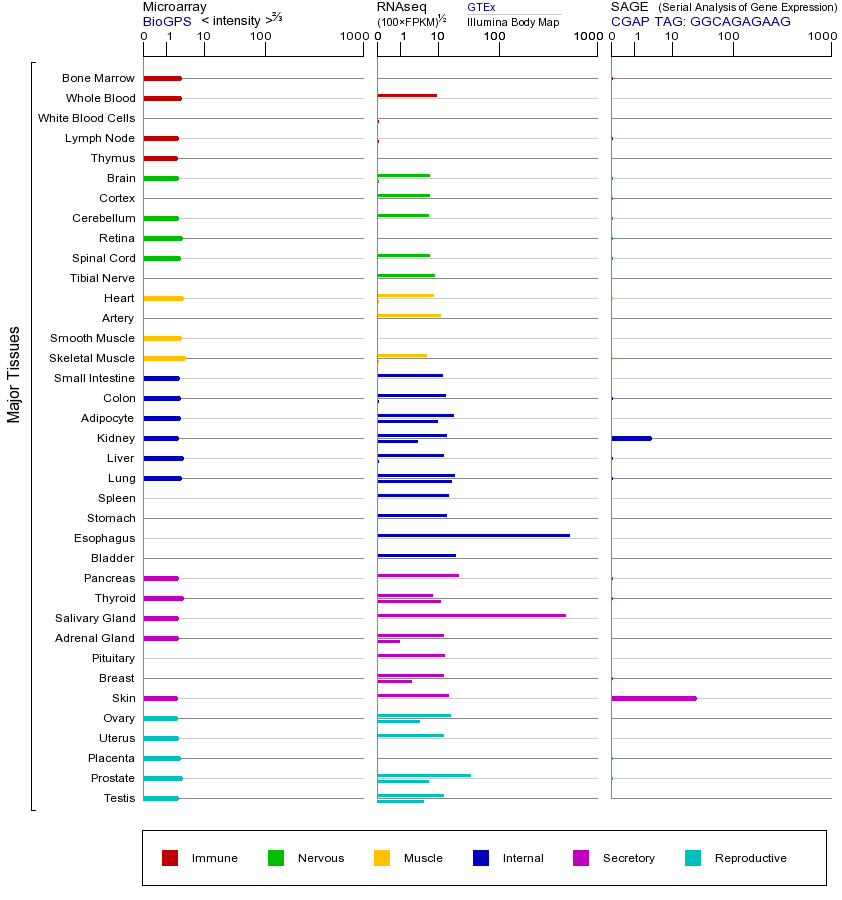
Tissue expression of KRT4:    [UniProt]

Gene expression across tissues
Forward Primer
Forward Tm
Reverse Primer
Reverse Tm
Score
CTTCATCGACAAGGTGCAG
59
CTGAGGTAGGTCTCAAAGAGG
59
GTGGTCCTAAAGAAGGACGT
60
CTCGTCATTAAGACTGTCCAC
59
CTTCATCGACAAGGTGCAG
59
TGAGGTAGGTCTCAAAGAGG
58
GTCCTAAAGAAGGACGTGG
58
GATCTCGTCATTAAGACTGTCC
59
TGTGGTCCTAAAGAAGGACG
60
TCGTCATTAAGACTGTCCACC
60
CTTCATCGACAAGGTGCAG
59
GAGGTAGGTCTCAAAGAGGG
59
Transcription Factors
Target Gene
Interaction Type
PubMed References
ELF3
KRT4
Repression

Subcellular localization of KRT4 (and its protein):

[UniProt]     [GenomeNet]

" d="M482.414,245.296c3.539,4.293,4.455,10.009,0.202,11 c-4.244,0.996-4.983-10.983-8.293-8.438c-5.271,4.08,9.834,12.271,5.144,17.287c-3.717,3.607-6.172-5.75-10.839-1.976 c-4.673,3.776,6.781,7.299,2.831,11.326c-4.354,4.045-6.979-1.449-9.837-5.517c-1.193-1.742-2.059-3.851-3.595-2.748 c-1.516,1.078-1.854,1.795-0.938,3.666c2.374,4.854,9.235,10.119,5.156,12.535c-5.636,3.346-5.044-8.871-9.426-7.574 c-4.388,1.291,2.557,10.66-1.245,11.141c-4.089,0.545-3.483-10.239-6.979-8.575c-2.522,1.206-0.929,3.071-0.938,4.899 c0.004,1.32-0.964,3.6-2.372,4.062c-3.593,1.171-8.544-1.065-10.251-3.59c-6.04-8.93,0.396-15.997,4.639-7.015 c3.023,4.642,5.182,0.834,2.839-2.219c-1.032-1.354-4.309-5.901-0.781-7.252c2.904-1.113,4.271,1.941,5.985,4.592 c2.61,4.016,5.485,0.117,3.031-3.414c-1.828-2.633-2.74-3.803,3.156-7.42c6.405-4.369,6.52,3.869,10.077,0.646 c2.309-1.832-4.783-5.149,0.06-8.995c2.896-2.293,5.18,6.207,7.961,3.516c3.523-2.737-7.717-7.369,0.117-11.736 C473.413,240.77,480.519,242.891,482.414,245.296z"/> Extracellular space Cytosol Plasma membrane Cytoskeleton Lysosome Endosome Peroxisome ER Golgi Apparatus Nucleus Mitochondrion 0 1 2 3 4 5 Confidence
  • plasma membrane
  • cytoplasm
  • extracellular
  • golgi
  • vesicle
  • cytoskeleton
  • endoplasmic reticulum
  • nucleus
  • endosome
  • lysosome
  • mitochondrion

Gene Ontology (GO) terms for KRT4:

GO ID
Protein
Source DB
GO:0005198
F8VX05 (UniProtKB)
IEA
GO:0005882
F8VX05 (UniProtKB)
IEA
GO:0005198
F8VZR6 (UniProtKB)
IEA
GO:0005882
F8VZR6 (UniProtKB)
IEA
GO:0005198
P19013 (UniProtKB)
IEA
GO:0005515
P19013 (UniProtKB)
IPI
GO:0005515
P19013 (UniProtKB)
IPI
GO:0005515
P19013 (UniProtKB)
IPI
GO:0005515
P19013 (UniProtKB)
IPI
GO:0005515
P19013 (UniProtKB)
IPI
GO:0005515
P19013 (UniProtKB)
IPI
GO:0005515
P19013 (UniProtKB)
IPI
GO:0005634
P19013 (UniProtKB)
IDA
GO:0005882
P19013 (UniProtKB)
NAS
GO:0007010
P19013 (UniProtKB)
IMP
GO:0007010
P19013 (UniProtKB)
NAS
GO:0009986
P19013 (UniProtKB)
IDA
GO:0030855
P19013 (UniProtKB)
ISS
GO:0045095
P19013 (UniProtKB)
IDA
GO:0045111
P19013 (UniProtKB)
IDA
GO:0050680
P19013 (UniProtKB)
ISS

microRNAs potentially regulating KRT4:     

BioGrid
IntAct
mentha
Loading…
Interacting Gene Interaction Source/Score
Disease Score NofPmids NofSnps Source
Leukokeratosis, Hereditary Mucosal 0.241628651 6 3 BeFree_CLINVAR_CTD_human
WHITE SPONGE NEVUS 1 0.2 1 0 MGD_UNIPROT
Contact Dermatitis 0.12 1 0 CTD_human
Squamous cell carcinoma of esophagus 0.000542884 2 0 BeFree
Bisphenol A exposure modulates ovarian cancer gene expression and oxidative stress markers: a case-control study.
Alsaeed SA, Lymona AM, Atef A, Moawad AM, Morsi H, Alkaffas M, Nassar A, Aboubakr HM Food Chem Toxicol IF: 3.2 2026-01-00
Proteomics analysis of serum extracellular vesicle identifies UCHL1 as a potential therapeutic target for high grade serous ovarian cancer.
Lokman NA, Macpherson AM, Thompson AR, Price ZK, Goonetilleke L, Condina MR, Young C, Hoffmann P, Oehler MK, Ricciardelli C Br J Cancer IF: 7.8 2026-01-00
MUC21 is downregulated in oral squamous cell carcinoma and associated with poor prognosis.
Mao L, Kang J, Zou A, Wang X, Guo S, Chen S, Su Y, Ge L, Yang J, Wang X Front Oncol IF: 3.4 None
Form Meets Function: Fiber Architecture Directs Proliferation and Differentiation in Gingival Keratinocytes.
Ramminger I, Steinberg T, Rolauffs B, Selig M, Tomakidi P Cells IF: 5.2 2026-02-05
Phenotypically anchored transcriptomics across diverse agrichemicals reveals conserved pathways and unique gene expression signatures in zebrafish.
St Mary L, McClure R, Truong L, Carrell SJ, Waters KM, Tanguay RL Front Toxicol IF: 4.6 2025-00-00
Proteomic characterization of plasma exosomes in drug-naïve schizophrenia: Insights into psychosis and cognitive dysfunction.
Sun X, Qiu Y, Ji L, Li M, Wang J, Su Q, Xuekelaiti Z, Bi F, Li J Psychiatry Res IF: 5.1 2025-09-00
Age-Associated Proteomic Changes in Human Spermatozoa.
Beg MA, Ismail AO, Alaiya A, Khan FA, Hamoda TAA, Sheikh IA, Sharma P, Baothman OM, Alkhzaim AH, Shinwari Z, Abuzinadah RF, Mohammed A, Assiri AM, Abuzenadah AM, Memili E, Feugang JM Int J Mol Sci IF: 3.687 2025-06-25

Loading comments...

Log in to post comments Log In Sign Up

Contact

No. 2 Wenbo Road, Zhangqiu District, Jinan, Shandong

Qilu Normal University · Genelibs Bioinformatics Lab

750 Shunhua Rd, Jinan

2F, Bldg F, University Science Park

Tel: 0531-88819269

WeChat Official Account

Follow our WeChat subscription account for real-time updates and the latest in medical and biological research.


Business Email

E-mail: [email protected]

