
RHO (rhodopsin)

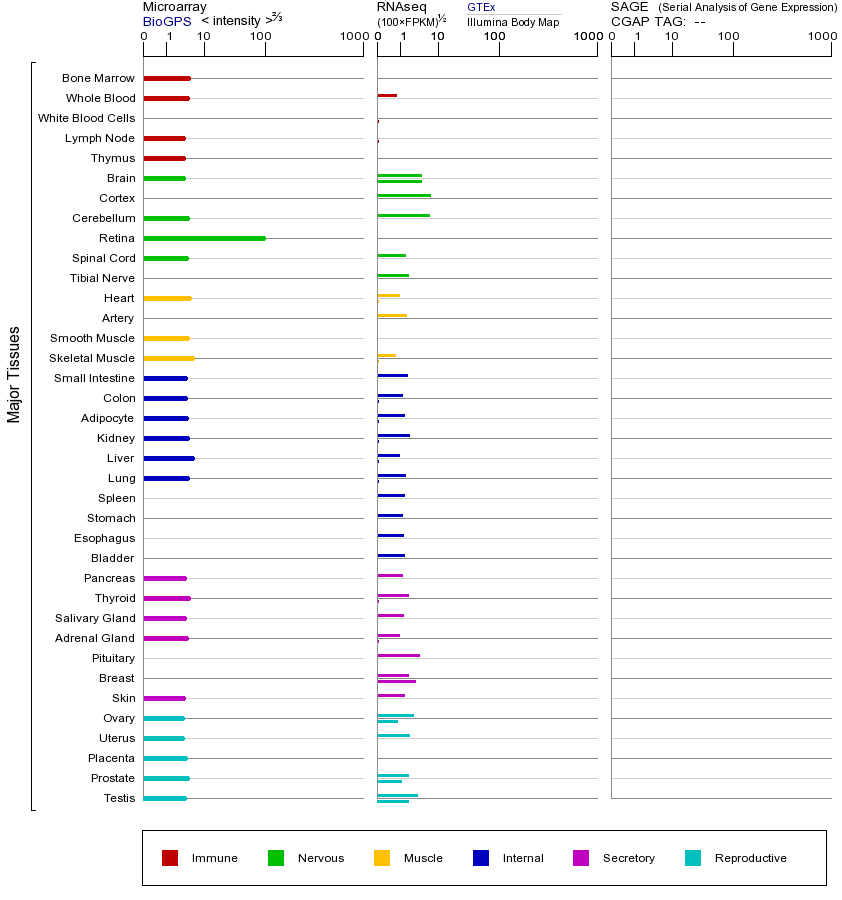
The RHO gene encodes rhodopsin, the principal photopigment of rod photoreceptor cells in the retina and a canonical member of the opsin subfamily of class A G protein-coupled receptors. Like all members of this receptor superfamily, rhodopsin is composed of seven transmembrane α-helices linked by extracellular and cytoplasmic loops, with a covalently bound 11-cis-retinal chromophore anchored in the seventh transmembrane helix that confers its exquisite spectral sensitivity to dim light. In the dark-adapted state the receptor rests in an inactive conformation; upon absorption of even a single photon, the 11-cis-retinal undergoes rapid isomerization to all-trans-retinal, driving a cascade of conformational rearrangements that convert the receptor to its active Metarhodopsin II form. This activated state engages the Gα subunit of transducin (GNAT1), which in turn stimulates phosphodiesterase-6 to hydrolyze cyclic GMP, causing closure of cGMP-gated cation channels in the outer-segment membrane and hyperpolarization of the rod cell, thereby transducing a light signal into the electrical response that is relayed through the retinal circuitry to the visual cortex. RHO is expressed almost exclusively in rod photoreceptors, where it is present in extraordinary abundance—on the order of ten million to ten million molecules per outer-segment disc—making rods the most light-sensitive cells in the human eye. Mutations in RHO constitute the single most frequent genetic cause of autosomal dominant retinitis pigmentosa (adRP), accounting for roughly twenty to thirty percent of all adRP cases, and the pathogenic spectrum encompasses missense substitutions, nonsense mutations, and small in-frame deletions. The two most prevalent missense alleles, P23H (a proline-to-histidine substitution in the first extracellular loop) and R135W (an arginine-to-tryptophan substitution in the sixth transmembrane helix), disrupt proper rhodopsin folding and trafficking, causing the misfolded protein to accumulate in the endoplasmic reticulum and chronically activate the unfolded protein response. Persistent ER stress, compounded by the toxic gain-of-function effects of certain mutants that aberrantly couple to transducin in the absence of light, ultimately engages apoptotic pathways and drives progressive rod cell death, which is followed secondarily by cone degeneration and the characteristic concentric constriction of the visual field. Conversely, hypomorphic or null mutations that reduce rhodopsin expression below a critical threshold impair the rod's capacity to generate a light response, manifesting clinically as nyctalopia and, in severe cases, congenital stationary night blindness. Phenotypic severity and age of onset vary considerably among RHO mutation carriers: mutations that perturb the cytoplasmic loops or the transducin-coupling interface tend to produce an aggressive, early-onset course with rapid photoreceptor loss, whereas those affecting the extracellular loops or the retinal-binding pocket often yield a milder, later-onset phenotype, underscoring the structure–function relationship that governs disease expression. This heterogeneity, together with the well-characterized molecular mechanisms underlying mutant rhodopsin toxicity, has made RHO one of the most intensively studied targets in retinal gene therapy, with strategies spanning antisense oligonucleotides, small-molecule chaperones, CRISPR/Cas9-mediated allele correction, and adeno-associated virus–mediated delivery of a corrected RHO transcript, all of which aim to restore proper rhodopsin homeostasis and halt the progressive photoreceptor degeneration that defines the disease.
Gene Ontology
Subcellular localization of RHO (and its protein):
- plasma membrane
- cytoplasm
- extracellular
- golgi
- vesicle
- cytoskeleton
- endoplasmic reticulum
- nucleus
- endosome
- lysosome
- mitochondrion
Gene Ontology (GO) terms for RHO:
| Interacting Gene | Interaction | Source/Score |
| Name |
|---|
| 4744 Phototransduction [PATH:hsa04744] |
| Name |
|---|
| Activation of the phototransduction cascade |
| Assembly of the primary cilium |
| Cargo trafficking to the periciliary membrane |
| Class A/1 (Rhodopsin-like receptors) |
| G alpha (i) signalling events |
| GPCR downstream signaling |
| GPCR ligand binding |
| Inactivation, recovery and regulation of the phototransduction cascade |
| Opsins |
| Organelle biogenesis and maintenance |
| Signaling by GPCR |
| The canonical retinoid cycle in rods (twilight vision) |
| The phototransduction cascade |
| Visual phototransduction |
| VxPx cargo-targeting to cilium |
| Disease | Score | NofPmids | NofSnps | Source |
| Retinitis Pigmentosa | 0.464557081 | 149 | 14 | BeFree_CLINVAR_CTD_human_GAD_LHGDN_ORPHANET |
| Night Blindness, Congenital Stationary, Autosomal Dominant 1 | 0.44 | 3 | 3 | CLINVAR_CTD_human_MGD_UNIPROT |
| Retinitis Pigmentosa 4 | 0.44 | 17 | 34 | CLINVAR_CTD_human_MGD_UNIPROT |
| Night blindness, congenital stationary | 0.241900093 | 7 | 2 | BeFree_CTD_human_ORPHANET |
| Fundus Albipunctatus | 0.240542884 | 2 | 0 | BeFree_CTD_human_ORPHANET |
| Retinal Degeneration | 0.130314791 | 39 | 3 | BeFree_CTD_human |
| Retinitis punctata albescens (disorder) | 0.122909916 | 2 | 1 | BeFree_CLINVAR_GAD |
| Autosomal dominant retinitis pigmentosa | 0.037925917 | 131 | 13 | BeFree_GAD |
| Retinal Diseases | 0.010987159 | 15 | 1 | BeFree_GAD_LHGDN |
| Night Blindness | 0.006991475 | 8 | 2 | BeFree_GAD_LHGDN |

Contact
No. 2 Wenbo Road, Zhangqiu District, Jinan, Shandong
Qilu Normal University · Genelibs Bioinformatics Lab
750 Shunhua Rd, Jinan
2F, Bldg F, University Science Park
Tel: 0531-88819269
WeChat Official Account
Follow our WeChat subscription account for real-time updates and the latest in medical and biological research.
Business Email
E-mail: [email protected]

Copyright © 2026.Genelibs Jinan Honghui Biotechnology Co., Ltd. 鲁ICP备20007159号-2
