
RXRB (retinoid X receptor beta)

symbol
RXRB
locus group
protein-coding gene
location
6p21.32
gene_family
Nuclear hormone receptors
alias symbol
NR2B2|H-2RIIBP|RCoR-1|RXRbeta|RXR-beta
alias name
nuclear receptor subfamily 2 group…
entrez id
6257
ensembl gene id
ENSG00000204231
ucsc gene id
uc003odb.5
refseq accession
NM_021976
hgnc_id
HGNC:10478
approved reserved
1991-11-14
6p21.32
ChineseEnglish

RXRB, or Retinoid X Receptor Beta, is a member of the nuclear receptor superfamily, specifically belonging to the Retinoid X Receptor (RXR) subfamily alongside RXRA and RXRG. As a ligand-dependent transcription factor, RXRB functions by binding to specific ligands, such as 9-cis-retinoic acid, to form either homodimers or heterodimers with other nuclear receptors, including the vitamin D receptor and thyroid hormone receptor. These receptor complexes bind to hormone response elements (HREs) within the regulatory regions of target genes, thereby modulating their transcriptional activity. This mechanism is central to the regulation of lipid metabolism, glucose homeostasis, inflammatory responses, and cellular differentiation, with RXRB playing a particularly significant role in the PPARα pathway governing fatty acid oxidation. The gene is predominantly expressed in metabolically active tissues, including the liver, kidneys, adipose tissue, and the immune system. Dysregulation of RXRB function, whether through loss-of-function or gain-of-function mutations that impair dimerization or ligand binding, is implicated in various pathological conditions, including metabolic syndrome, diabetes, and certain cancers such as thyroid carcinoma. While overexpression of RXRB can enhance lipolysis and improve insulin sensitivity, excessive activation may paradoxically trigger apoptosis or autoimmune reactions, whereas reduced expression is associated with adiposity, chronic inflammation, and exacerbated metabolic disorders. The RXR family's ability to form diverse dimeric combinations allows for a broad regulatory scope, underscoring its critical role in both developmental processes and metabolic homeostasis.
Nucleotide sequence of RXRB:[NCBI]
Loading Gene Browser...
Protein Sequence
1MSWAARPPFL PQRHAAGQCG PVGVRKEMHC GVASRWRRRR
41PWLDPAAAAA AAVAGGEQQT PEPEPGEAGR DGMGDSGRDS
81 RSPDSSSPN PLPQGVPPPS PPGPPLPPST APSLGGSGAP
121PPPPMPPPPL GSPFPVISSS MGSPGLPPPA PPGFSGPVSS
161P QINSTVSL PGGGSGPPED VKPPVLGVRG LHCPPPPGGP
201GAGKRLCAIC GDRSSGKHYG VYSCEGCKGF FKRTIRKDLT
241YS CRDNKDC TVDKRQRNRC QYCRYQKCLA TGMKREAVQE
281ERQRGKDKDG DGEGAGGAPE EMPVDRILEA ELAVEQKSDQ
321GVE GPGGTG GSGSSPNDPV TNICQAADKQ LFTLVEWAKR
361IPHFSSLPLD DQVILLRAGW NELLIASFSH RSIDVRDGIL
401LATG LHVHR NSAHSAGVGA IFDRVLTELV SKMRDMRMDK
441TELGCLRAII LFNPDAKGLS NPSEVEVLRE KVYASLETYC
481KQKYP EQQG RFAKLLLRLP ALRSIGLKCL EHLFFFKLIG
521DTPIDTFLME MLEAPHQLA
Structure predicted by AlphaFold DB(UniProt: P28702). Color indicates pLDDT confidence (dark blue = high, yellow/orange = low).
SNP variants of RXRB:           Showing partial SNPs
rs1050673       rs1050673       rs1050673       rs1050673       rs1050673       rs1050673       rs1546877       rs1546877       rs1546877       rs1546877       rs1546877       rs1546877       rs2072915       rs2072915       rs2072915       rs2072915       rs2072915      

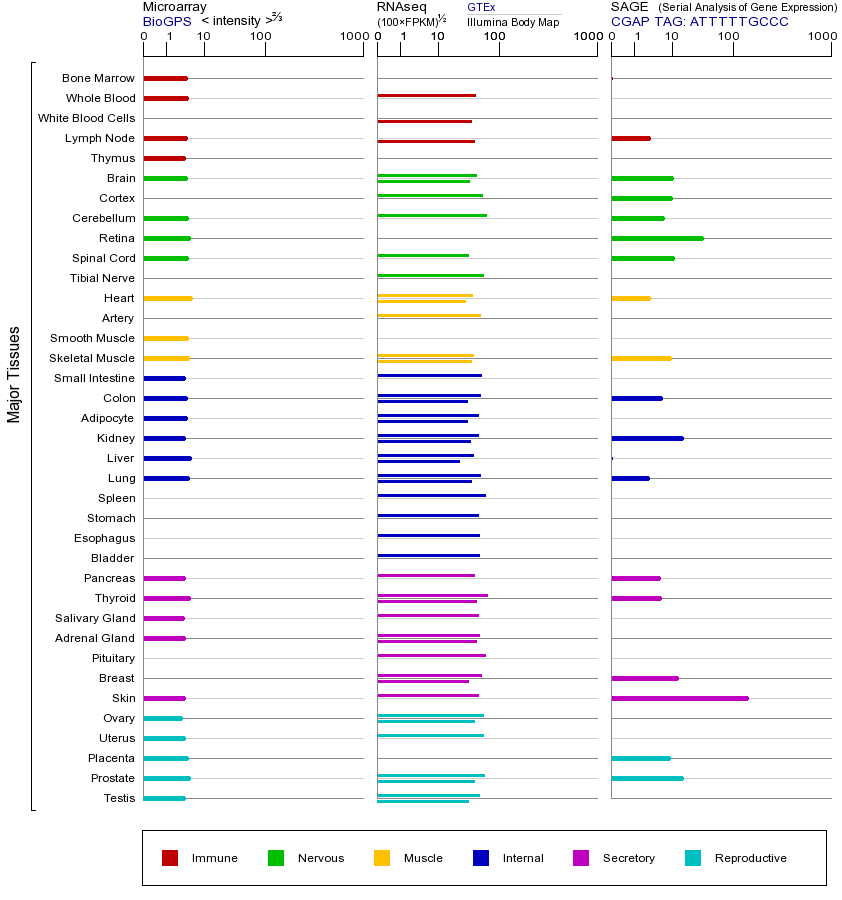
Tissue expression of RXRB:    [UniProt]

Gene expression across tissues
Forward Primer
Forward Tm
Reverse Primer
Reverse Tm
Score
AACAGAAGTACCCTGAGCAG
60
CACTTAAGGCCAATGGACC
59
CAGAAGCTCAGGCAAACAC
60
AGTATGTAAGGTCTTTGCGGA
59
CAGAAGCTCAGGCAAACAC
60
GTAAGGTCTTTGCGGATGG
59
AACAGAAGTACCCTGAGCA
58
CACTTAAGGCCAATGGACC
59
CAGAAGCTCAGGCAAACAC
60
TAAGGTCTTTGCGGATGGT
59
ACAGAAGTACCCTGAGCAG
59
CACTTAAGGCCAATGGACC
59

Subcellular localization of RXRB (and its protein):

[UniProt]     [GenomeNet]

" d="M482.414,245.296c3.539,4.293,4.455,10.009,0.202,11 c-4.244,0.996-4.983-10.983-8.293-8.438c-5.271,4.08,9.834,12.271,5.144,17.287c-3.717,3.607-6.172-5.75-10.839-1.976 c-4.673,3.776,6.781,7.299,2.831,11.326c-4.354,4.045-6.979-1.449-9.837-5.517c-1.193-1.742-2.059-3.851-3.595-2.748 c-1.516,1.078-1.854,1.795-0.938,3.666c2.374,4.854,9.235,10.119,5.156,12.535c-5.636,3.346-5.044-8.871-9.426-7.574 c-4.388,1.291,2.557,10.66-1.245,11.141c-4.089,0.545-3.483-10.239-6.979-8.575c-2.522,1.206-0.929,3.071-0.938,4.899 c0.004,1.32-0.964,3.6-2.372,4.062c-3.593,1.171-8.544-1.065-10.251-3.59c-6.04-8.93,0.396-15.997,4.639-7.015 c3.023,4.642,5.182,0.834,2.839-2.219c-1.032-1.354-4.309-5.901-0.781-7.252c2.904-1.113,4.271,1.941,5.985,4.592 c2.61,4.016,5.485,0.117,3.031-3.414c-1.828-2.633-2.74-3.803,3.156-7.42c6.405-4.369,6.52,3.869,10.077,0.646 c2.309-1.832-4.783-5.149,0.06-8.995c2.896-2.293,5.18,6.207,7.961,3.516c3.523-2.737-7.717-7.369,0.117-11.736 C473.413,240.77,480.519,242.891,482.414,245.296z"/> Extracellular space Cytosol Plasma membrane Cytoskeleton Lysosome Endosome Peroxisome ER Golgi Apparatus Nucleus Mitochondrion 0 1 2 3 4 5 Confidence
  • plasma membrane
  • cytoplasm
  • extracellular
  • golgi
  • vesicle
  • cytoskeleton
  • endoplasmic reticulum
  • nucleus
  • endosome
  • lysosome
  • mitochondrion

Gene Ontology (GO) terms for RXRB:

GO ID
Protein
Source DB
GO:0003677
A0A0G2JHI1 (UniProtKB)
IEA
GO:0003707
A0A0G2JHI1 (UniProtKB)
IEA
GO:0005634
A0A0G2JHI1 (UniProtKB)
IEA
GO:0006351
A0A0G2JHI1 (UniProtKB)
IEA
GO:0006355
A0A0G2JHI1 (UniProtKB)
IEA
GO:0008270
A0A0G2JHI1 (UniProtKB)
IEA
GO:0043401
A0A0G2JHI1 (UniProtKB)
IEA
GO:0003700
A0A0G2JKR7 (UniProtKB)
IEA
GO:0003707
A0A0G2JKR7 (UniProtKB)
IEA
GO:0005634
A0A0G2JKR7 (UniProtKB)
IEA
GO:0006351
A0A0G2JKR7 (UniProtKB)
IEA
GO:0006355
A0A0G2JKR7 (UniProtKB)
IEA
GO:0008270
A0A0G2JKR7 (UniProtKB)
IEA
GO:0043401
A0A0G2JKR7 (UniProtKB)
IEA
GO:0043565
A0A0G2JKR7 (UniProtKB)
IEA
GO:0000977
P28702 (UniProtKB)
IDA
GO:0001228
P28702 (UniProtKB)
IDA
GO:0003700
P28702 (UniProtKB)
NAS
GO:0003707
P28702 (UniProtKB)
IEA
GO:0003713
P28702 (UniProtKB)
TAS
GO:0004879
P28702 (UniProtKB)
IDA
GO:0004886
P28702 (UniProtKB)
IEA
GO:0005515
P28702 (UniProtKB)
IPI
GO:0005515
P28702 (UniProtKB)
IPI
GO:0005515
P28702 (UniProtKB)
IPI
GO:0005515
P28702 (UniProtKB)
IPI
GO:0005634
P28702 (UniProtKB)
IDA
GO:0005654
P28702 (UniProtKB)
TAS
GO:0005654
P28702 (UniProtKB)
TAS
GO:0005654
P28702 (UniProtKB)
TAS
GO:0006367
P28702 (UniProtKB)
TAS
GO:0008270
P28702 (UniProtKB)
IEA
GO:0030375
P28702 (UniProtKB)
IEA
GO:0031641
P28702 (UniProtKB)
IEA
GO:0042809
P28702 (UniProtKB)
IEA
GO:0042974
P28702 (UniProtKB)
IEA
GO:0043401
P28702 (UniProtKB)
IEA
GO:0045944
P28702 (UniProtKB)
IDA
GO:0046966
P28702 (UniProtKB)
IEA
GO:0046982
P28702 (UniProtKB)
IEA
GO:0048384
P28702 (UniProtKB)
IEA
GO:2000273
P28702 (UniProtKB)
IEA

microRNAs potentially regulating RXRB:     

String
BioGrid
IntAct
mentha
MINT
Reactome
Loading…
Interacting Gene Interaction Source/Score
Disease Score NofPmids NofSnps Source
Mammary Neoplasms 0.12 1 0 CTD_human
Disease Progression 0.12 1 0 CTD_human
Stomach Neoplasms 0.12 1 0 CTD_human
Prostatic Neoplasms 0.00272435 1 0 LHGDN
Lung Neoplasms 0.00272435 1 0 LHGDN
Diabetes Mellitus, Insulin-Dependent 0.002638474 1 0 BeFree_GAD
Schizophrenia 0.002638474 1 0 BeFree_GAD
Spontaneous abortion 0.002367032 1 0 GAD
Chronic Obstructive Airway Disease 0.002367032 1 0 GAD
Psoriasis 0.002367032 1 0 GAD
Monocytes from patients with chronic non-bacterial osteomyelitis (CNO) exhibit increased 'classically activated' phenotypes and altered DNA methylation patterns.
Carlsson E, Godoy-Tena G, Morbach H, Girschick HJ, Dissanayake D, Charras A, Ballestar E, Hedrich CM Clin Immunol IF: 4.1 2026-08-00
Romboutsia ilealis related metabolite OAA controls obesity and lipid metabolism through PSMD3-mediated degradation of YTHDF2.
Zhu L, Huang L, Liu S, Luo S, Li Y, Wang Y, Zong X Cell Death Differ IF: 13.6 2026-03-17
Epigenetic Signatures of Frailty: A Systematic Review, Meta-Analysis, and Network Analysis of the Chemical Exposome.
Cedillo-Rivero AE, Rodriguez-Cuartas JD, Gomez-Zapata V, Flores-Soto E, Gomez-Verjan JC, Rivero-Segura NA Int J Mol Sci IF: 3.226 2026-07-03
Differences of PPARD Expression in the Liver of Cattle with Different Marbling Grades.
Wang K, Wang Q, Wang Q, Tian S, Qi Y, Zhang L, Xing B, Tuliguer, Li Q Animals (Basel) IF: 3.2 2026-07-06
In Silico Multitarget Profiling of Betulinic Acid: ADME/Protox-II Toxicity, Network Pharmacology, and Molecular Docking for Diabetic Osteoporosis.
Sharma S, Chaudhary R, Sharma C, Dabral S, Bansal S, Sharma N, Gupta S Curr Drug Discov Technol 2026-08-06
Genome-wide CRISPR screens identify an RXR-MYLIP-LDLR axis regulating BH3 mimetic sensitivity in peripheral T-cell lymphomas.
Yokoyama K, Chiba M, Takei N, Suto K, Ishio T, Goto H, Endo T, Kadin ME, Maeda M, Watanabe M, Hatakeyama S, Teshima T, Yang Y, Nakagawa M Oncogene IF: 9.1 2026-08-25
Effect of food enrichment based on diverse feeding regimes on the immunity of Nibea albiflora by biochemical and RNA-seq analysis of the spleen.
Xu A, Zheng Y, Zhang X, Xu D, Wang J, Sun J Comp Biochem Physiol Part D Genomics Proteomics IF: 2.9 2025-03-00

Loading comments...

Log in to post comments Log In Sign Up

Contact

No. 2 Wenbo Road, Zhangqiu District, Jinan, Shandong

Qilu Normal University · Genelibs Bioinformatics Lab

750 Shunhua Rd, Jinan

2F, Bldg F, University Science Park

Tel: 0531-88819269

WeChat Official Account

Follow our WeChat subscription account for real-time updates and the latest in medical and biological research.


Business Email

E-mail: [email protected]

