
TYROBP (transmembrane immune signaling adaptor TYROBP)

symbol
TYROBP
locus group
protein-coding gene
location
19q13.12
gene_family
-
alias symbol
DAP12|PLO-SL|KARAP
alias name
killer activating receptor associa…
entrez id
7305
ensembl gene id
ENSG00000011600
ucsc gene id
uc002ocm.4
refseq accession
NM_001173514
hgnc_id
HGNC:12449
approved reserved
1998-06-25
19q13.12
ChineseEnglish

TYROBP, also known as DAP12 or KARAP, encodes a transmembrane signaling adaptor protein that serves as a critical component of the immunoreceptor signaling complex family. Primarily expressed in innate immune cells such as natural killer cells, macrophages, dendritic cells, and specific T-cell subsets, TYROBP lacks its own ligand-binding domain but functions by non-covalently associating with various single-pass transmembrane receptors, including members of the TREM family and SIRPβ1. The intracellular domain of TYROBP contains an immunoreceptor tyrosine-based activation motif (ITAM); upon ligand engagement of the associated receptor, this motif is phosphorylated, thereby recruiting and activating Syk or ZAP70 kinases to initiate downstream signaling cascades. These pathways regulate essential cellular processes, including activation, proliferation, cytokine secretion, phagocytosis, and migration, thereby modulating both innate immune responses and inflammatory homeostasis. Genetic mutations in TYROBP can lead to loss-of-function phenotypes, most notably in Nasu-Hakola disease, a rare autosomal recessive disorder where defects in TYROBP or its partner TREM2 impair osteoclast and microglial function, resulting in early-onset dementia and bone cysts. Furthermore, TYROBP plays a significant role in neurodegenerative contexts; dysregulated expression may compromise microglial inflammatory responses and the clearance of amyloid-beta plaques, contributing to the pathogenesis of Alzheimer’s disease. Conversely, aberrant overexpression can drive excessive immune activation and autoimmunity, while reduced expression may weaken immune surveillance, increasing susceptibility to infections and tumorigenesis. As a core member of the TREM receptor signaling complex family, TYROBP exemplifies the conserved mechanism whereby ITAM-bearing adaptors translate extracellular ligand binding into intracellular kinase activation, ultimately governing cellular effector functions in health and disease.
Nucleotide sequence of TYROBP:[NCBI]
Loading Gene Browser...
Protein Sequence
1MGGLEPCSRL LLLPLLLAVS GLRPVQAQAQ SDCSCSTVSP
41GVLAGIVMGD LVLTVLIALA VYFLGRLVPR GRGAAEAATR
81 KQRITETES PYQELQGQRS DVYSDLNTQR PYYK
Structure predicted by AlphaFold DB(UniProt: O43914). Color indicates pLDDT confidence (dark blue = high, yellow/orange = low).
SNP variants of TYROBP:           Showing partial SNPs
rs14714       rs14715       rs1802029       rs8105153       rs8106480       rs74610942       rs75330483       rs113207157       rs140727973       rs142104996       rs182961452       rs200170675       rs369642701       rs370284045       rs371385905       rs372342355       rs372703196      

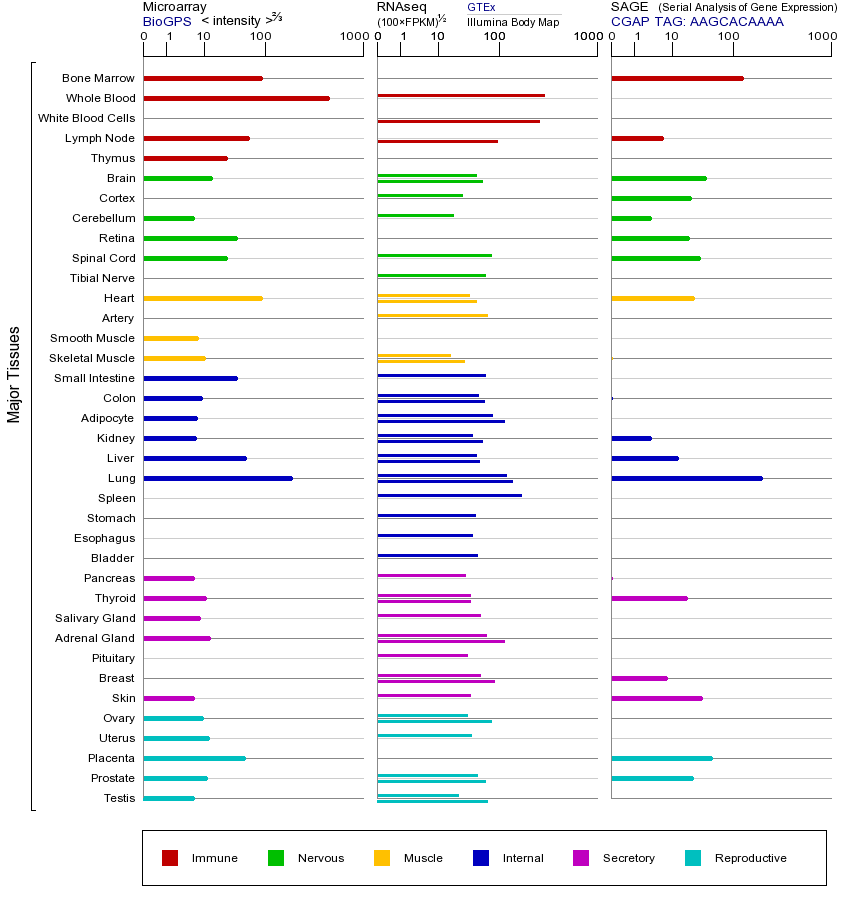
Tissue expression of TYROBP:    [UniProt]

Gene expression across tissues
Forward Primer
Forward Tm
Reverse Primer
Reverse Tm
Score
CTGTAAGTGGTCTCCGTCC
60
CAGTGATACGCTGTTTCCG
59
ATTGCAGTTGCTCTACGGT
60
CTGGAGCTCCTGATAAGGC
60
CTGGCTGTAAGTGGTCTCC
60
CAATGAGCACTGTCAGCAC
60
CCTTACACTGTGGTGTCCA
59
GGACGGAGACCACTTACAG
60
GATTGCAGTTGCTCTACGG
59
CTGGAGCTCCTGATAAGGC
60
CTGTAAGTGGTCTCCGTCC
60
AGCACCTCCATTACCATCC
59
GATTGCAGTTGCTCTACGG
59
CTGGAGCTCCTGATAAGGC
60
CTGGCTGTAAGTGATTGCAG
59
CAATGAGCACTGTCAGCAC
60
GATTGCAGTTGCTCTACGG
59
CTGGAGCTCCTGATAAGGC
60
CTGTAAGTGGTCTCCGTCC
60
TTTGGAAAGGGTGTGGGAG
60

Subcellular localization of TYROBP (and its protein):

[UniProt]     [GenomeNet]

" d="M482.414,245.296c3.539,4.293,4.455,10.009,0.202,11 c-4.244,0.996-4.983-10.983-8.293-8.438c-5.271,4.08,9.834,12.271,5.144,17.287c-3.717,3.607-6.172-5.75-10.839-1.976 c-4.673,3.776,6.781,7.299,2.831,11.326c-4.354,4.045-6.979-1.449-9.837-5.517c-1.193-1.742-2.059-3.851-3.595-2.748 c-1.516,1.078-1.854,1.795-0.938,3.666c2.374,4.854,9.235,10.119,5.156,12.535c-5.636,3.346-5.044-8.871-9.426-7.574 c-4.388,1.291,2.557,10.66-1.245,11.141c-4.089,0.545-3.483-10.239-6.979-8.575c-2.522,1.206-0.929,3.071-0.938,4.899 c0.004,1.32-0.964,3.6-2.372,4.062c-3.593,1.171-8.544-1.065-10.251-3.59c-6.04-8.93,0.396-15.997,4.639-7.015 c3.023,4.642,5.182,0.834,2.839-2.219c-1.032-1.354-4.309-5.901-0.781-7.252c2.904-1.113,4.271,1.941,5.985,4.592 c2.61,4.016,5.485,0.117,3.031-3.414c-1.828-2.633-2.74-3.803,3.156-7.42c6.405-4.369,6.52,3.869,10.077,0.646 c2.309-1.832-4.783-5.149,0.06-8.995c2.896-2.293,5.18,6.207,7.961,3.516c3.523-2.737-7.717-7.369,0.117-11.736 C473.413,240.77,480.519,242.891,482.414,245.296z"/> Extracellular space Cytosol Plasma membrane Cytoskeleton Lysosome Endosome Peroxisome ER Golgi Apparatus Nucleus Mitochondrion 0 1 2 3 4 5 Confidence
  • plasma membrane
  • cytoplasm
  • extracellular
  • golgi
  • vesicle
  • cytoskeleton
  • endoplasmic reticulum
  • nucleus
  • endosome
  • lysosome
  • mitochondrion

Gene Ontology (GO) terms for TYROBP:

GO ID
Protein
Source DB
GO:0016021
K7ES93 (UniProtKB)
IEA
GO:0002281
O43914 (UniProtKB)
IEA
GO:0002283
O43914 (UniProtKB)
IEA
GO:0005057
O43914 (UniProtKB)
TAS
GO:0005102
O43914 (UniProtKB)
IPI
GO:0005102
O43914 (UniProtKB)
IPI
GO:0005102
O43914 (UniProtKB)
IPI
GO:0005515
O43914 (UniProtKB)
IPI
GO:0005515
O43914 (UniProtKB)
IPI
GO:0005515
O43914 (UniProtKB)
IPI
GO:0005622
O43914 (UniProtKB)
IEA
GO:0005886
O43914 (UniProtKB)
TAS
GO:0005886
O43914 (UniProtKB)
TAS
GO:0005886
O43914 (UniProtKB)
TAS
GO:0005886
O43914 (UniProtKB)
TAS
GO:0005886
O43914 (UniProtKB)
TAS
GO:0005886
O43914 (UniProtKB)
TAS
GO:0005886
O43914 (UniProtKB)
TAS
GO:0005886
O43914 (UniProtKB)
TAS
GO:0005886
O43914 (UniProtKB)
TAS
GO:0005886
O43914 (UniProtKB)
TAS
GO:0005886
O43914 (UniProtKB)
TAS
GO:0005886
O43914 (UniProtKB)
TAS
GO:0005886
O43914 (UniProtKB)
TAS
GO:0005886
O43914 (UniProtKB)
TAS
GO:0005886
O43914 (UniProtKB)
TAS
GO:0005886
O43914 (UniProtKB)
TAS
GO:0005886
O43914 (UniProtKB)
TAS
GO:0005886
O43914 (UniProtKB)
TAS
GO:0005886
O43914 (UniProtKB)
TAS
GO:0005886
O43914 (UniProtKB)
TAS
GO:0005886
O43914 (UniProtKB)
TAS
GO:0005886
O43914 (UniProtKB)
TAS
GO:0005886
O43914 (UniProtKB)
TAS
GO:0005886
O43914 (UniProtKB)
TAS
GO:0005886
O43914 (UniProtKB)
TAS
GO:0005886
O43914 (UniProtKB)
TAS
GO:0005886
O43914 (UniProtKB)
TAS
GO:0005887
O43914 (UniProtKB)
TAS
GO:0006968
O43914 (UniProtKB)
TAS
GO:0007165
O43914 (UniProtKB)
TAS
GO:0007229
O43914 (UniProtKB)
IEA
GO:0009986
O43914 (UniProtKB)
IDA
GO:0035556
O43914 (UniProtKB)
TAS
GO:0042802
O43914 (UniProtKB)
IPI
GO:0045087
O43914 (UniProtKB)
TAS
GO:0050776
O43914 (UniProtKB)
TAS
GO:2001204
O43914 (UniProtKB)
IEA
GO:0016021
X6RGC9 (UniProtKB)
IEA
String
BioGrid
IntAct
mentha
Reactome
Loading…
Interacting Gene Interaction Source/Score
Disease Score NofPmids NofSnps Source
POLYCYSTIC LIPOMEMBRANOUS OSTEODYSPLASIA WITH SCLEROSING LEUKOENCEPHALOPATHY 0.442985861 11 5 BeFree_CLINVAR_CTD_human_MGD_ORPHANET
IGA Glomerulonephritis 0.12 1 0 CTD_human
Liver diseases 0.12 1 0 CTD_human
Inflammation 0.00272435 1 0 LHGDN
Malignant neoplasm of ovary 0.002367032 1 0 GAD
Presenile dementia 0.001628651 6 0 BeFree
Bone Cysts 0.001085767 4 0 BeFree
Dementia 0.000814326 3 0 BeFree
Osteodysplasia 0.000542884 2 0 BeFree
Schizophrenia 0.000542884 2 0 BeFree
Integrated single-cell and bulk transcriptomic analyses reveal cellular and molecular mechanisms of ABC-type DLBCL progression and prognosis.
Chen N, Zhou T, Fei Y, Hu D, Yun X, Zhu P, Zhang Q, Ji Y, Ni H, Zhan S Discov Oncol 2026-03-13
Blue artificial light at night is associated with cognitive impairment involving alterations in microglial TREM2-TYROBP signaling and phospholipid metabolism: A multi-omics study.
Sun Z, Lei T, Tan S, Liu X, Wang X, Gao X, Quan X, Zhang C, Xue M, Yang T, Hua H Ecotoxicol Environ Saf IF: 6.6 2026-08-22
ITAM-Syk signaling mediates the rebound phenomenon after anti-RANKL antibody discontinuation.
Ishizu H, Hasegawa T, Shimizu T, Yamamoto T, Asano T, Iwasaki N, Amizuka N Bone IF: 3.9 2026-04-00

Loading comments...

Log in to post comments Log In Sign Up

Contact

No. 2 Wenbo Road, Zhangqiu District, Jinan, Shandong

Qilu Normal University · Genelibs Bioinformatics Lab

750 Shunhua Rd, Jinan

2F, Bldg F, University Science Park

Tel: 0531-88819269

WeChat Official Account

Follow our WeChat subscription account for real-time updates and the latest in medical and biological research.


Business Email

E-mail: [email protected]

